
What should you use for your next cut and what is more worth the risk: Clenbuterol vs Albuterol? These two compounds can’t be used together (if you value your heart at least a little), so you have to ultimately choose just one. We’ll try to help with just that.
Clenbuterol Basics
Clenbuterol, commonly known as just Clen, is primarily used as a bronchodilator in the treatment of respiratory conditions.
Outside of the medical realm, however, Clenbuterol’s primary off-label use is fat burning.
It’s a classic beta-2 agonist that helps you to lose weight even when you don’t work out, passively, and selectively, with no damage to the muscle tissue whatsoever.
Albuterol Basics
Albuterol, also known as salbutamol, is another beta-2 adrenergic agonist. It’s also commonly prescribed for the treatment of asthma and similar diseases.
Albuterol shares a similar mechanism of action with Clenbuterol, acting on the beta-2 adrenergic receptors, but it’s different in a whole list of aspects, including the way it actually works.
Albuterol is way less popular in the bodybuilding world for two primary reasons: not as potent as Clen and harder to get.
Here’s a direct comparison of the way the two compounds work: there’s just no better way to see the difference.
Clenbuterol Mechanism of Action
Clen belongs to a class of drugs called beta-2 adrenergic agonists.
- When administered, Clen selectively binds to and activates beta-2 adrenergic receptors;
- Activation of these receptors leads to the activation of an enzyme called adenylate cyclase;
- It converts adenosine triphosphate (ATP) into cyclic adenosine monophosphate (cAMP);
- cAMP levels go up and trigger the activation of protein kinase A (PKA);
- PKA activation leads to the phosphorylation of several proteins involved in fat metabolism, including hormone-sensitive lipase (HSL);
- HSL starts to break down all the triglycerides stored in fat cells;
- As the result, free fatty acids can be utilized as an energy source;
- Ultimately, this cascade reaction leads to the conversion of fat into energy.
In addition, Clen increases the rate of lipolysis (fat mobilization) by boosting perilipin, a protein involved in the regulation of fat storage and release.
Albuterol Mechanism of Action
Albuterol, like Clenbuterol, belongs to the class of beta-2 adrenergic agonists. It selectively activates beta-2 adrenergic receptors when administered. It’s ALMOST the same as Clen:
- Same binding to beta-2 receptors, but more selectively in the respiratory system (so it’s more effective as an asthma drug);
- Same effect on adenylate cyclase that converts ATP into cAMP, but it’s happening at a slower rate, compared to Clen;
- cAMP just the same way triggers PKA and starts the phosphorylation;
- And as a result, elevated HSL gets to work, turning fat into energy (ultimately, just heat, raising your body temperature a bit).
While the mechanism of action for Albuterol is similar to Clenbuterol up to this point, there is one notable difference:
Albuterol has a more selective effect on beta-2 adrenergic receptors compared to Clenbuterol. This selectivity means that Albuterol primarily works as it is intended to work, as a bronchodilator, not a fat loss compound. It still does help, but it’s just less effective.
Let’s put it this way:
The ability to burn fat in Clenbuterol was a bug. A glitch, not an intended feature. Albuterol has this bug almost fixed, though it is still possible to exploit it to some degree.
The result here is simple: Albuterol is more popular as a prescription drug for asthma, and Clen is more popular as a weight loss compound.
The Practical Differences Between Clenbuterol vs Albuterol
Despite the difference in efficiency, both Clenbuterol and Albuterol are still widely discussed in the bodybuilding community.
And when it comes to practical differences as a fat loss agent, Clen kind of loses the fight.
Half-life
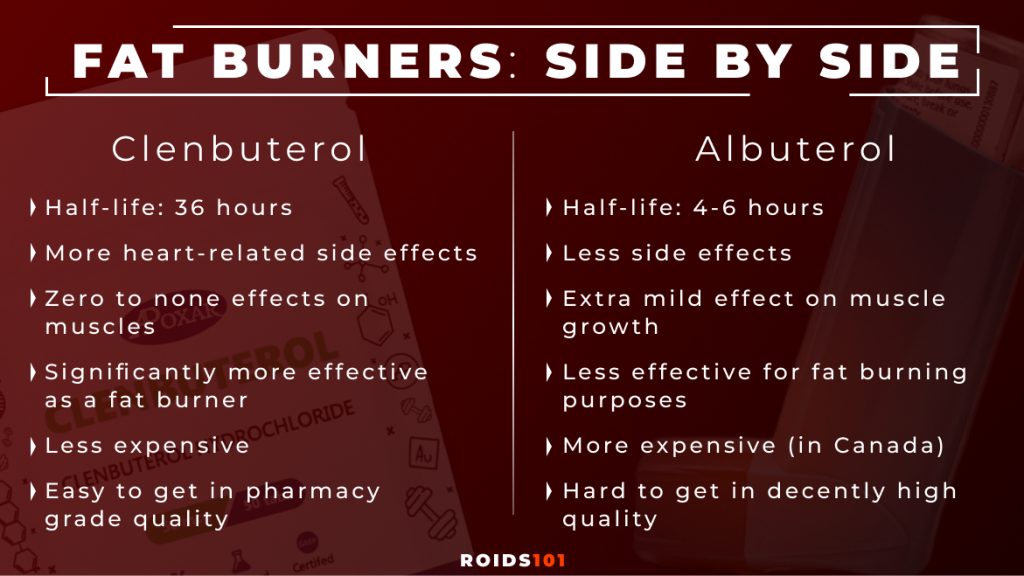
Albuterol has a relatively short half-life of only 4-6 hours, whereas Clenbuterol’s half-life is about 36 hours.
This means that Albuterol levels in the body may be higher during waking hours and lower during sleep.
In contrast, Clenbuterol levels remain constant throughout the day and night, potentially causing sleep disturbances.
And it’s not just sleep: longer half-life in Clen means more pronounced side effects.
Effects on muscle fibers
Clenbuterol has been shown in some animal studies to affect sodium channels in cardiac tissue, but in practical bodybuilding use, it is valued for its anti-catabolic properties—helping preserve muscle mass during a cut, not weakening it. Albuterol, on the other hand, does not have this adverse effect and may even lead to a slight increase in strength.
It’s not that clear or well-researched, though. For example, this study comparing Clenbuterol and Albuterol effects in elderly individuals with muscle wasting found that both salbutamol (Albuterol) can help stimulate muscle growth. Salbutamol showed similar effects to Clenbuterol in increasing muscle weight and protein content. These findings suggest that Salbutamol may be a more accessible option for further research and clinical trials in older adults with muscle loss.
Cardiac risks
According to multiple studies, Clenbuterol appears to pose a greater risk to the heart compared to Albuterol. Clen has been associated with cardiac lesions, whereas Albuterol has been proven to be milder on your heart.
Receptor specificity
Clenbuterol activates beta-3 receptors in addition to beta-2, while Albuterol is highly selective for beta-2. However, the significance of beta-3 activation for fat loss in humans is still debated and likely minimal compared to beta-2 stimulation.
The importance of beta-3 receptors in humans is still debated, but their activation may provide some benefits for fat loss. In this regard, Clenbuterol has an advantage.
Other Aspects of Clen and Albuterol to Consider
So far, Albuterol wins 3 to 1.
Availability
You can buy Clenbuterol in high-quality pretty much everywhere, including our store. It’s one of the most popular fat burners in the bodybuilding world, with even Lazar Angelov being open about using it. Albuterol is available in oral tablet form (2mg and 4mg) in many countries, though it’s less common than inhalers. Finding pharmaceutical-grade oral Albuterol can be trickier than Clen, which is widely stocked by underground labs specifically for fat loss.
Sure, for people with asthma, Albuterol inhalers are a much better option: faster onset, better selectivity to the respiratory system… but for fat loss? Not really.
The Price
Top-quality Clenbuterol costs 80$ for 50 tablets of 50 mcg, and the price has been the same for years. Finding a decent plug (again, we have a store, duh) is easier than finding some black market Viagra. With Albuterol, most of the time, the consensus is that it’s “not worth the money” and probably not worth the risk of getting some inhalable bootleg BS from a sketchy scam shop.
Because of its short half-life, Albuterol requires multiple daily doses to maintain effects, whereas one Clen dose covers the whole day. This makes Albuterol less convenient for all-day coverage but allows for better sleep and less receptor desensitization.
So, in short:
- Clen: more heart risks, easy to get, acts longer, messes with your muscles, more effective for fat loss purposes;
- Albuterol: also has heart risks, hard to get, shorter half-life, less muscle tissue fuckery, less effective for fat loss.
And in the super short version, condensed to just one statement:
Albuterol is Clen Light but both can fuck with your health.
Now it’s 3 – 3, and Clen wins in practicality.
Clenbuterol vs Albuterol Side Effects
Here, we won;’t choose a winner. This part is intended to highlight the status of Albuterol as a Clen Light. You’ll see for yourself:
Clenbuterol Side Effects:
In simple terms, there’s A LOT:
- Increased heart rate (tachycardia);
- Elevated blood pressure (hypertension);
- Muscle tremors or shaking;
- Insomnia or sleep disturbances;
- Increased perspiration;
- Nervousness or anxiety;
- Headaches;
- Nausea or vomiting;
- Cardiac hypertrophy (enlargement of the heart muscle) at high doses;
- Risk of cardiac arrhythmias;
- Electrolyte imbalances.
Prolonged use of higher doses of Clen doesn’t just give you jitters, it may cause irreversible damage to your heart.
Albuterol Side Effects:
Albuterol is pretty much the same, but much less dangerous:
- Again the increased heart rate (tachycardia);
- Shaking or tremors in the hands;
- Nervousness or restlessness;
- Headaches;
- Muscle cramps;
- Dizziness or lightheadedness;
- Dry mouth or throat;
- Nausea;
- Palpitations.
Albuterol is generally considered milder than Clenbuterol, with a lower risk of long-term cardiac damage when used at therapeutic doses. However, high-dose or chronic abuse can still lead to cardiovascular strain, including persistent tachycardia and electrolyte imbalances.
Let’s sum it up:
Clen:
- Has a higher likelihood of side effects (compared to Albuterol);
- Can cause insomnia or sleep disturbances (Albuterol will not);
- May lead to vomiting (just nausea for Albuterol);
- Carries a risk of enlargement of the heart muscle at high doses (Albuterol does not).
Albuterol:
- Generally milder side effects compared to Clenbuterol;
- Commonly reported side effects include just the traditional for beta-2 agonists jitters or tremors in the hands and nervousness.
Albuterol is Clen Light in all aspects, both in terms of effectiveness and the side effects.
What About the Clen, Ketotifen and Yohimbine Stack?
The famous stack we’ve talked about in full detail here in our guide to Clenbuterol effectiveness boosters is clearly a whole different option. It allows you to mitigate some of the side effects of Clenbuterol and boosts the synergistic effect of all three compounds, but still: it’s not as harmless as Albuterol, just way more effective.
In simple terms, taking Clen with Ketotifen and Yohimbine, possibly with T3 Cytomel, justifies the increased side effects and boosts the cutting cycle’s effectiveness dramatically. Especially in comparison with Albuterol solo.
How to Actually Run Clen vs Albuterol
Theory is great, but when the vial is in your hand, you need numbers. Here’s the practical breakdown of how to dose Clenbuterol and Albuterol for fat loss, including ramp-up schedules, cycle length, and why “more” is rarely “better.”
| Parameter | Clenbuterol | Albuterol |
| Standard Dose | 40-120 mcg per day | 16-24 mg per day (split into 4mg doses) |
| Half-Life | 36-48 hours (very long) | 4-6 hours (very short) |
| Dosing Frequency | Once daily (morning) | Every 4-6 hours while awake |
| Cycle Length | 2 weeks on, 2 weeks off | 4-6 weeks continuous |
| Ramp-Up Protocol | Start at 20mcg, increase by 20mcg every 3-4 days until target dose | Start at 4mg 3x daily, increase to 4mg 4x daily if tolerated |
| Beta-2 Receptor Saturation | Occurs in ~18 days (receptors downregulate) | Minimal saturation; can run longer without breaks |
| Peak Blood Levels | Stable 24/7 (constant stimulation) | Peaks 1-2 hours after dose, then declines |
| Best Taken | First thing in AM to avoid insomnia | Pre-workout and early afternoon (avoid late doses) |
Final Word
At the end of the day the choice here depends on your personality and goals:
- Are you the type of guy to go “Low and Slow” while staying safe? Go for Albuterol and don’t expect miracles to happen. You’ll lose weight slowly, but in a safer manner;
- Maybe you’re the “All or Nothing” type of guy? You want it fast and no matter what? Then Clenbuterol is clearly a better option;
- And if you’re not a Sith dealing in absolutes, someone who likes to look for the optimal solution, you need Clen in combination with Ketotifen, Yohimbine, and maybe T3. In a direct comparison of Clenbuterol vs Albuterol, this third option takes the cake when it comes to cost- and risk-effectiveness.
Keep in mind: even with optimal dosing, these compounds are just a tool—typically accounting for 8-15% of your total metabolic rate. The other 85-90% still comes from diet, NEAT, and training. No pill replaces discipline.”